The procedural safeguards required by the Individuals with Disabilities Education Act (IDEA) are intended to protect the rights of children with disabilities and their families and guide Early Intervention and Preschool Special Education systems and programs in meeting these requirements.
For a full review of Procedural Safeguards as listed under IDEA Part C please see: https://www.ecfr.gov/current/title-34/subtitle-B/chapter-III/part-303/subpart-E
A summary of sections as they apply to PIC:
Confidentiality of Information (§ 303.415)
- Agencies must protect personally identifiable information at all stages (collection, maintenance, use, storage, disclosure, and destruction).
- A designated official in each agency is responsible for ensuring confidentiality.
- Personnel handling such information must receive training on state policies and procedures.
- Agencies must maintain a public list of employees who have access to this information.
Enforcement (§ 303.417)
- The lead agency must implement policies, procedures, and sanctions to ensure compliance with confidentiality and procedural safeguards.
- Individuals have the right to file complaints if policies are not followed.
Parental Consent and Rights (§ 303.420)
- Parental consent is required before screenings, evaluations, services, use of insurance, or disclosure of identifiable information.
- If a parent refuses consent, agencies must ensure the parent understands the consequences.
- Agencies cannot use due process hearings to challenge a parent's decision to withhold consent.
- Parents have the right to accept or decline services at any time without jeopardizing other services.
Prior Written Notice (§ 303.421)
- Parents must receive written notice before any changes in their child’s identification, evaluation, placement, or services.
- The notice must explain the proposed/refused action, reasons for it, and available procedural safeguards.
- Notices must be in the parent's native language or mode of communication, with translation provided if necessary.
PIC’s practice to ensure procedural safeguards are followed as IDEA law requirements. Best practice includes reviewing the forms in relationship with the associated visit/action .
Sending Family Signature Forms
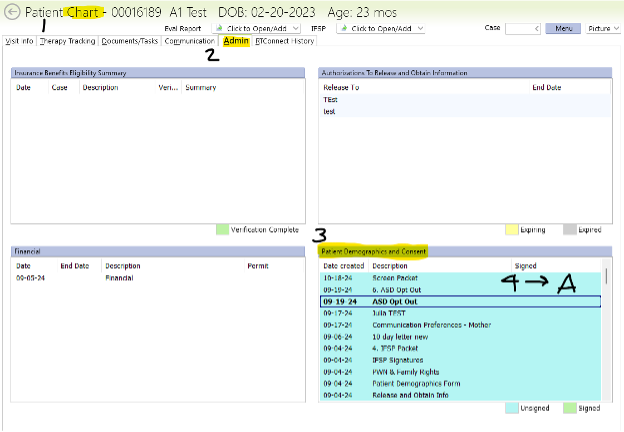
- In RT go to the Admin tab of the child’s Chart, in the Patient Demographics and Consent section and “a” to add
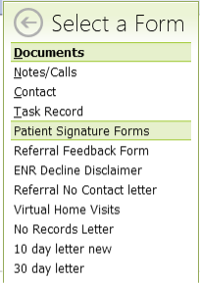
- Select ”Patient Signature Forms” and then the corresponding form set
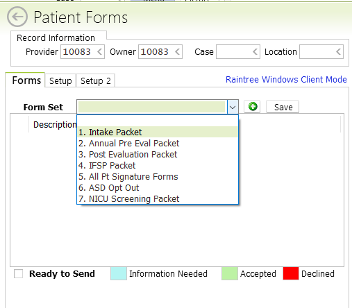
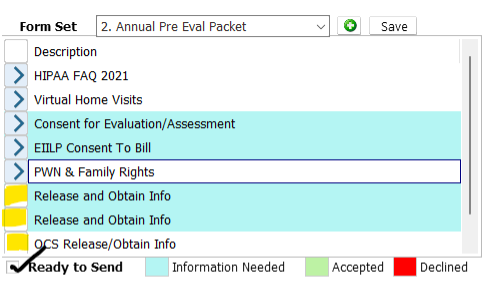
- Many forms require additional information provided by the direct service provider. These include:
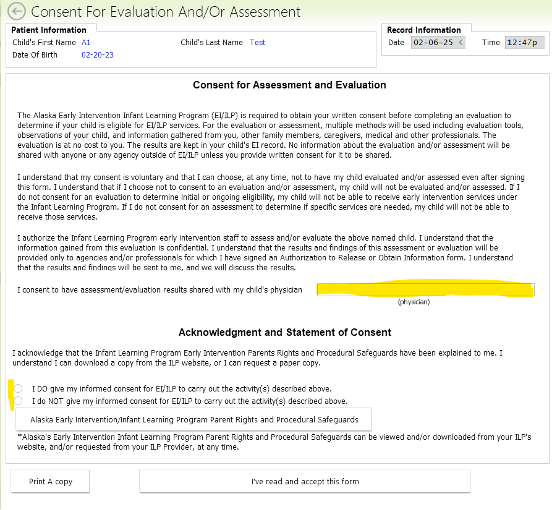
- Consent for Evaluation/Assessment- requires the name of the child’s primary care provider (PCP). If the family does NOT want the evaluation shared with the PCP or they do not have a PCP, then it should be left blank. If the family does not give consent for the evaluation, we should not proceed with the evaluation.
- EI/ILP Consent to Bill- this is an expanding form based on the information given. This is automatically pulled from the insurance information we have on file to make this easier for the family, however if we do not have the information, the family is required to fill it out. There is a box to check if the family doesn’t know the Medicaid/Denali KidCare number. All other insurances need to have, at minimum, the Insurance Name & ID number filled out. The last step is to denote if permission is given or NOT given before accepting the form. Consent to Bill a child’s insurance is up to the family but does NOT impact the services the child will receive.
- PWN & Family Rights- this is a multipurpose form that can be associated with the intake, eligibility determination meeting, IFSP meetings, and annual packets. It needs to be completed so that it corresponds with the appointment type it’s concerning. It requires the name of the child’s authorized representative (or family of [child’s name]), the box checked for the reason notice is being provided, and someone associated with PIC as the signer (this does not necessarily need to be the PSP, RT automatically pulls the current listed PSP and it can’t be changed). Additional information for the family in the text box “The reason this action(s) is being proposed is:" is REQUIRED and should family oriented.
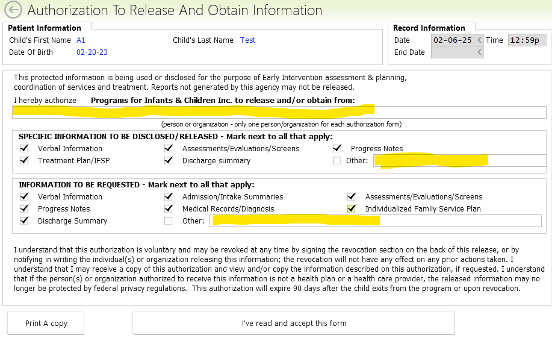
- Release and Obtain Information- this fulfills our HIPAA and FERPA requirements for safeguards of PHI. We need to specifically state what information can be released and requested by checking the boxes or filling in the “Other” boxes. This ROI is valid for the length of the child’s enrollment + 90 days. The family may revoke the permission at any time by signing a hard copy ROI (the back side has a revocation section).
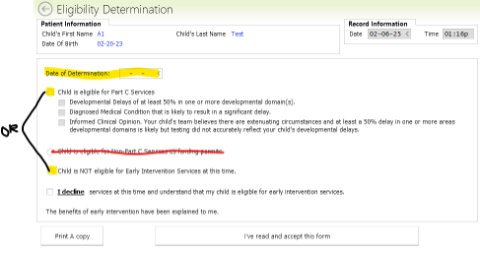
Eligibility Determination- this requires information from the evaluation. The Date of Determination is the date of the evaluation. If the child is eligible, the type of eligibility needs to be indicated. If the child is NOT eligible, the other radio button needs to be selected. We do not enroll Non-Part C children, so that box can never be checked.
The family can decline services at enrollment (or re-enrollment) by checking the “I decline” box.
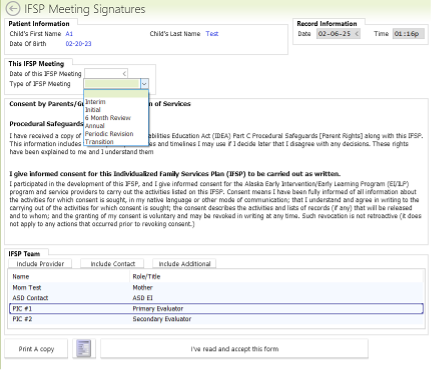
- IFSP Meeting Signatures- this requires the correct date of the IFSP Meeting, most important type of meeting (if combination IFSP of more than one “type” taking place at one meeting), and the full IFSP team. The IFSP team should include the primary and secondary evaluators if associated with an Initial or Annual IFSP, since both providers impacted eligibility. The IFSP team should also include any outside attendees, most commonly ASD during the Transition Conference. Family members should always been included when present.
- Consent for Evaluation/Assessment- requires the name of the child’s primary care provider (PCP). If the family does NOT want the evaluation shared with the PCP or they do not have a PCP, then it should be left blank. If the family does not give consent for the evaluation, we should not proceed with the evaluation.
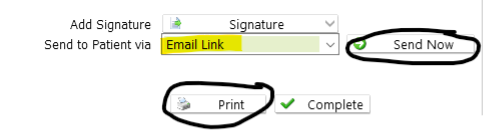
- Once all forms are prepared, check the “Ready to Send” button. Any forms NOT needed (unchecked) will NOT be sent to the family. Choose the “Email Link” drop down option and then Send Now if sending electronically OR you can also print hard copy forms for the family to sign with the “Print” button.