
Last Updated
Purpose
The IDEA safeguards for billing are summarized below and are the purpose of PIC’s Consent to Bill form.
Summary of § 303.520 – Policies on Public Benefits, Insurance, and Private Insurance for Part C Services
- Use of Public Benefits or Insurance
- A State may use a child’s or parent’s public benefits (e.g., Medicaid) for Part C services only after providing written notification and ensuring certain no-cost protections.
- Parents cannot be required to enroll in public benefits as a condition for receiving services.
- Parental consent is required if using public benefits would:
- Reduce available coverage or benefits.
- Result in out-of-pocket costs for parents.
- Increase premiums or discontinue benefits.
- Risk loss of eligibility for Medicaid waivers.
- If a parent refuses consent, the State must still provide approved Part C services.
- Use of Private Insurance
- A State cannot use private insurance to pay for Part C services without parental consent unless a State law protects against:
- Loss of benefits due to coverage caps.
- Negative impact on insurance availability.
- Increased insurance premiums.
- Consent is needed when:
- Private insurance is first used for a service.
- There is an increase in service levels.
- If parents may incur costs (e.g., co-pays, deductibles), these must be identified in State policies.
- A State cannot use private insurance to pay for Part C services without parental consent unless a State law protects against:
- Inability to Pay
- If a family cannot afford private insurance costs and does not consent to its use, services cannot be delayed or denied.
- Use of Funds from Public or Private Insurance
- Reimbursements from public or private insurance are not considered State or local funds.
- Medicaid reimbursements are also not considered State or local funds.
- Parent Payments Under a State's System
- Payments made by parents under a State's system of payments are program income and must be used for early intervention services but are not counted as State or local funds.
Practice
PIC’s practice in regard to Consent to Bill (CTB) signature form is as follows:
- At Intake, the form is reviewed by their primary service provider. PIC’s HIT/billing team follows up with the family if more information is needed, if the family unexpectedly chose to deny consent (to confirm it was intentional), or to review visit limits if the family has private insurance and have OT, PT or ST on their IFSP.
- When a billable service (PT, OT, or ST) is added or frequency is increased, outside of an evaluation (initial or annual), a new CTB is required. PIC's practice is complete this regardless of insurance, however the State's requirement is only for children with private insurance since this impacts billing of their private insurance. PIC’s HIT/billing team follows up with the family to review visit limits if needed.
- If the child’s insurance changes, a new form is needed. PIC’s HIT/billing team follows up to review visit limits if needed.
- Annually at the child’s re-evaluation. Again, PIC’s HIT/billing team follows up to review visit limits if needed.
Families may revoke their consent to bill insurance at any time.
Procedure
Completing the CTB:
- At Intake, send intake packet with the CTB to the family via the Admin Tab in RainTree for signature. When preparing the form, if we have any insurance information already in the child's chart it will prepopulate on the form, but the family has the ability to edit and/or add correct information as needed. The PIC provider needs to add an "as of" date (highlighted yellow below). This should be the Intake appointment date.
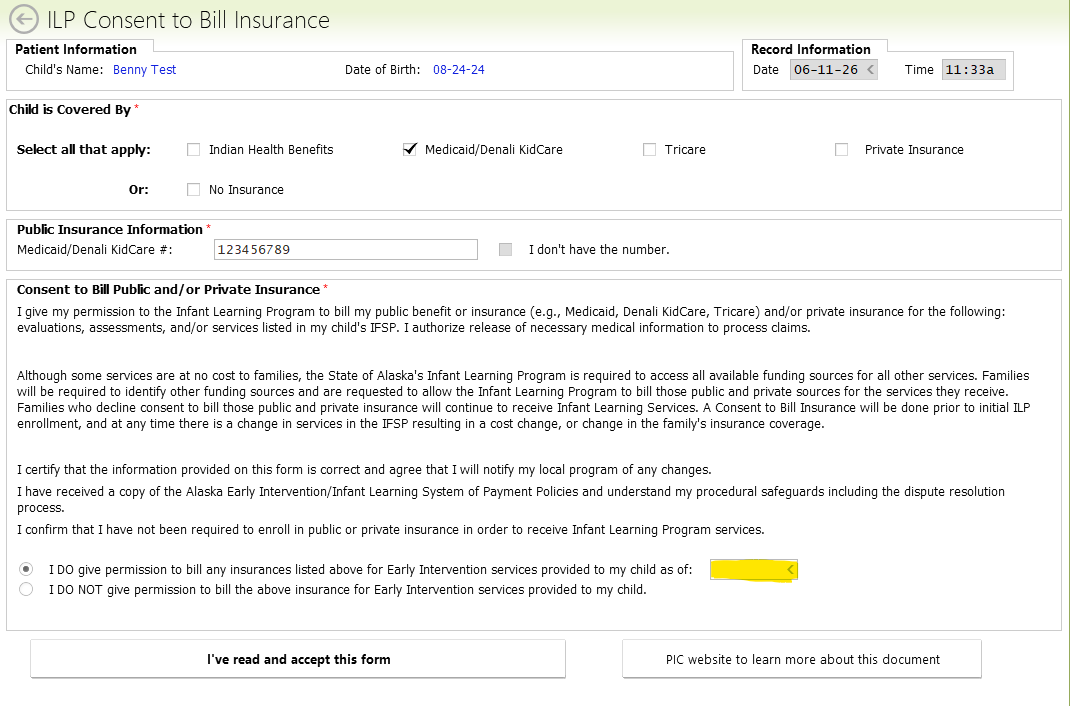
- When a billable service (PT, OT, or ST) is added or frequency is increased, send a CTB to the family via the Admin Tab in RainTree for signature. The PIC provider needs to add an "as of" date. This should be the IFSP appointment date when the services were increased.
- If the child’s insurance changes, a new form is needed. send a CTB to the family via the Admin Tab in RainTree for signature. The PIC provider needs to add an "as of" date. This should be the child's insurance changed.
- Annually at the child’s re-evaluation, send an annual re-eval packet with a CTB to the family via the Admin Tab in RainTree for signature. The PIC provider needs to add an "as of" date. This should be the re-evaluation date.
When consent is denied:
The PSP will inform the HIT team via hit@picak.org and make a Call Log Note the day the consent is denied. Give the family a new Consent to Bill signature form and have them choose that they "DO NOT give permission".
Consent to Bill & PIC Families
- PIC services are free to families. This means that any service not covered by insurance is written off. It does not mean we are a free service, we send claims to all available insurance.
- Why should a family give consent to bill if they have Private Insurance?
- PIC's services can help reduce their deductible, allowing them to pay less out of pocket.
- Why would a family deny consent to bill?
- If kiddo has Private Insurance, they are seeing outside therapists and want to save visit limits.
- My family doesn't know if they have visit limits, what now?
- Any time an IFSP is completed with new billable services the HIT team will research the insurance and try to contact the family to explain the visit limits and PIC's billing policy to them.
- What happens if a family has Private Insurance and Medicaid?
- Any claims not paid by the Private Insurance will be sent to Medicaid. Anything not covered by Medicaid will be written off.
- A family I work with wants to revoke Consent to Bill, what do I do?
- Inform the HIT team via hit@picak.org and make a Call Log Note the day the consent is denied. Give the family a new Consent to Bill signature form and have them choose that they "DO NOT give permission".