
The Plan of Care (POC) is completed for each child after the provider and family have collaboratively developed goals on the IFSP. These IFSP goals form the foundation of the POC, and are automatically carried over to reflect those goals. The POC also serves as a communication tool with the child’s Primary Care Provider (PCP) and supports PIC’s ability to bill Medicaid and other insurance providers.
Most insurance payers, including Medicaid, require a POC signed by the child’s PCP in order to authorize reimbursement for services. While PIC strongly encourages families to maintain a relationship with a PCP to support the child’s overall health and care coordination, a signed POC is not required for a child to receive services through PIC.
Children who have a POC in place will have a regular update that is aligned with any IFSP renewal. This increases our compliance and prevents gaps in coverage. The POC will be updated regularly for the signing PCP's information.
Alaska is a Direct Access State, meaning that under state licensure regulations, therapy services can be provided without a physician’s referral or a signed POC. However, reimbursement from Medicaid and most commercial insurances typically requires a PCP-signed POC.
PIC providers request an ROI for the PCP from parents at intake.
Initial POC
After the evaluation and IFSP, the provider generates a POC and assigns secondary providers to the POC goals, if appropriate.
PIC providers must complete the POC upon completing the IFSP so that subsequent sessions are billable from their signature date, provided the PCP signs within 14 days. The Health Information Team (HIT) assures the signatures meet timelines and will inform the PIC providers of concerns.
PIC provider’s timely completion of the POC prevents gaps in PIC’s ability to bill for services that children receive.
POC Updates
POC renewals or updates occur when there is an IFSP update, revision or renewal. this keeps the documenation aligned and prevents gaps in coverage. Regular updates are required (no less than 1x every 6 months and at IFSP renewals).
Upon completion of the IFSP, providers create a POC in the child’s chart.
Long-term goals are transferred from the IFSP completed with the family:
- In RainTree, open a Plan of Care for the child.
- Complete each tab including Treatment Plan and Recommendations. Update Progress only for renewal POC. Where indicated, use the green cross at the bottom of the box to add set phrases.
- On the Treatment Tab, as required by Medicaid provide a prognosis, and a certification period. This should be about 6 months from the date of the POC but no more than. Best practice is to align the certification date with the IFSP date.
- In each goal, the Main Tab was completed with the IFSP process. Proceed to the IFSP tab and confirm that the previous entered information from the IFSP process is included in the IFSP:
F10 to return to the POC.
Complete all tabs and their boxes, then:
- Save and Sign off
- Any secondary providers will have a task sent to them notifying that the IFSP goals are completed and they can complete their own plan of care
Note: Once an IFSP is signed by the primary, no new long-term goals can be signed without the Primary Provider creating a revision to the IFSP. Revisions require a new IFSP be created and require parent’s signatures that correspond to the date of the parent signature.
Short-term goals can be added to the POC without a signature from the family.
Secondary POC
All long-term goals need to be entered into the RainTree system through the IFSP process. The primary provider will assign any additional providers to goals. Secondaries, may not start a POC until the primary has added them to the IFSP goals.
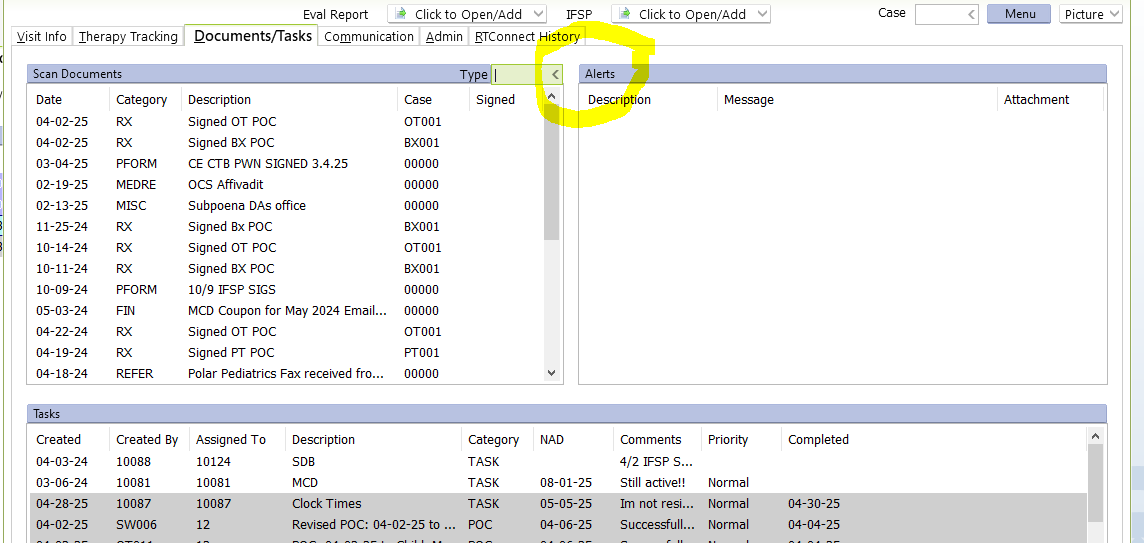
Upon opening a new POC, the secondary provider will find the assigned goals automatically appear. Secondary provider number will appear in the boxes indicated above--if not assure that they are "the assigned provider number" and "Therapist" and match.
<INSERT SNIP here>
Then, the Secondary provider may proceed with entering Short-term Goals.
Adding Short-Term Goals
Switch to the Main tab and enter Short-term Goals at bottom of page:
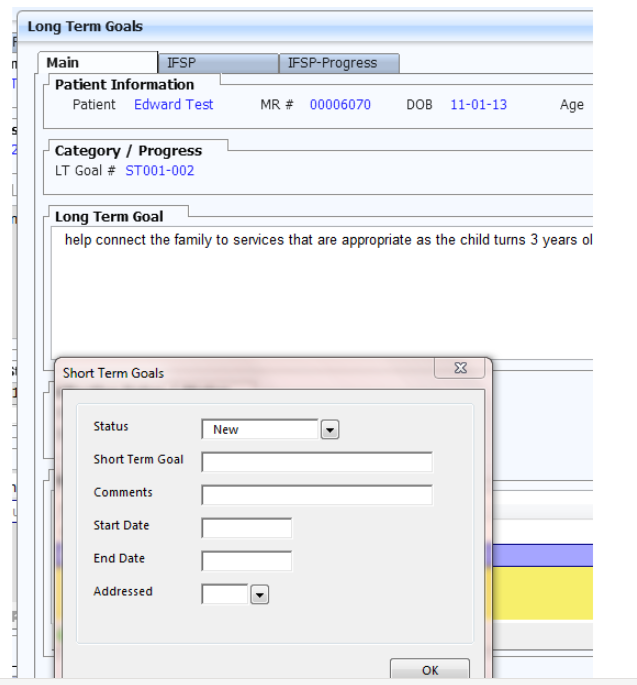
At bottom of page, A to Add New in Short term goals
Click on New and then complete the Short-term Goal boxes (these boxes will accommodate about 250 characters)
F10 to save.
F10 to return to the POC
When you have added all the goals, Save and Sign off.
POC Updates
Upon completion of the IFSP the provider updates the POC, reviewing each box and indicating if the goals are continued, discontinued or met. Each short-term goal will have a short update included in the comments box. When updating a POC, unaddressed goals—future milestones meant to be tackled later in a progressive sequence should not be left blank,or blank. Comment on the goal will be clearly documented with the status as pending future intervention to preserve the continuity of treatment steps. Providers will indicate that the goal is pending in the following or similar: Not yet addressed--foundational goals must be achieved to accomplish this goal.